Modern pet euthanasia usually follows a gentle sequence: sedation first so your pet becomes relaxed and unaware, then an injection of a death-inducing drug that brings a peaceful passing. In an in-home setting, this happens in familiar surroundings, with your family nearby and a veterinarian focused on comfort and dignity.
If you’re asking what happens during euthanasia, you may be sitting beside an aging dog, holding a sick cat, or trying to prepare for an appointment that feels impossible to imagine. Knowing the steps won’t remove the sadness, but it can replace some fear with steadier expectations.
The veterinarian will explain what they’re doing, watch your pet closely, and confirm the passing before discussing aftercare. You can ask questions, take pauses, change the setting, or decide how much of the process you want to witness. There isn’t one correct way to say goodbye.
Table of Contents
- A Compassionate Look at the Euthanasia Process
- Preparing Your Home and Your Heart
- The First Step How Sedation Helps Your Pet Relax
- The Final Injection How a Peaceful Passing Happens
- What You May See After Your Pet Has Passed
- Aftercare Choices and Honoring Your Pet’s Memory
A Compassionate Look at the Euthanasia Process
This question carries a great deal of weight. Families often want reassurance, but they also deserve a clear explanation of what their pet will experience and what they may see.
An in-home euthanasia appointment generally has three broad phases:
- Preparation and arrival: The veterinarian talks with you, reviews your pet’s comfort, answers questions, and settles everyone in a familiar space.
- Sedation: A calming medication helps your pet drift into deep, peaceful sleep. The goal is to ease anxiety, pain, and awareness before the final medication.
- The final injection: Once your pet is fully relaxed and unaware, the veterinarian gives a death-inducing drug that brings a peaceful passing.
This process reflects the modern veterinary emphasis on a rapid, painless, and distress-free death. The AVMA euthanasia guidelines explain that euthanasia methods should account for the animal’s physiologic and behavioral responses, as well as the effects on the people performing or observing the procedure.
Your permission matters: You can ask the veterinarian to pause, explain a step again, or give you time before proceeding.
Your pet’s comfort remains the central concern throughout the visit. If a pet is frightened, painful, difficult to handle, or medically unstable, the veterinarian may adjust the plan. Some species and circumstances require methods other than the injection commonly used for dogs and cats, but the same principles apply: reduce distress, protect dignity, and confirm death carefully.
The sections below follow the appointment in the order it usually unfolds. You’ll learn how to prepare your home, what sedation looks like, how the final medication works, which reflexes may occur afterward, and what choices come next.
Preparing Your Home and Your Heart
Before the veterinarian arrives, choose the place where your pet seems most at ease. It might be a favorite bed in the living room, a patch of sunlight, the bedroom floor, or your arms if your companion still wants to be held. A familiar location can make the visit feel less like a medical event and more like a quiet family goodbye.
Place a washable blanket beneath your pet and keep favorite bedding nearby. You may also want a beloved toy, a small treat if eating remains comfortable, family photographs, or a handwritten note. These items aren’t required, but they can help you focus on the relationship rather than the procedure.

Choosing who should be present
Think about who will feel comforted by being there and who may become overwhelmed. Adults can take different roles. One person may hold the pet, another may speak with the veterinarian, and someone else may care for children or manage a phone call afterward.
Children can be included when the explanation is honest and suited to their age. Use clear words such as, “The veterinarian will give the medicine that helps your pet’s body stop working because they are very sick.” Avoid saying the pet is going to sleep, since young children may later become afraid of bedtime.
Give children choices without making them responsible for the decision. They might draw a picture, offer a favorite blanket, say goodbye before the appointment, or stay for part of the visit. Let them know that crying, silence, questions, and changing their mind are all acceptable.
Other pets may notice the change in the home and react to unfamiliar people or strong emotions. Keep them in a quiet nearby room if they become anxious, or allow calm observation if the veterinarian agrees and everyone feels safe. Close doors, reduce noise, and keep the household routine as steady as possible.
For practical questions about bedding, access, children, and the room itself, families can review this guide on preparing the home before the veterinarian arrives.
You can also choose soft music, lower lighting, or a candle placed safely away from bedding. Some families sit on the floor, while others prefer a chair beside their companion. The right setting is the one that lets your pet feel secure and lets you remain emotionally present.
This short video may help families visualize how a calm home visit can unfold:
The First Step How Sedation Helps Your Pet Relax
At Heartstrings Pet Hospice, in-home euthanasia begins with a sedative injection. The medication is usually given under the skin or into a muscle, rather than directly into a vein, so your pet can begin relaxing without the pressure of immediate restraint for the final injection.
The veterinarian may start by speaking softly, examining your pet, and choosing the least stressful position. You can remain close, stroke the head, or offer reassurance in the way your companion knows best. The injection itself is intended to be a small part of a much larger comfort-focused process.
Sedation reduces anxiety and awareness. It can also soften discomfort and allow tense muscles to release. As the medication takes effect, your pet may become sleepy, less responsive, and increasingly unaware of the room around them.
What the transition may look like
Families often notice gradual changes rather than one dramatic moment:
- Breathing changes: Breaths may begin heavily or unevenly, then become slower and more relaxed.
- Muscles soften: The jaw, face, legs, and body may lose their earlier tension.
- Awareness fades: Your pet may stop responding to voices or touch while remaining physically comfortable.
- Rest deepens: Eventually, your companion lies in a deep, dreamlike sleep and doesn’t appear aware of the veterinarian’s movements.
Every animal responds differently. A very ill pet may become sleepy quickly, while another may need more time or an adjustment in medication. The veterinarian watches breathing, posture, muscle tone, and responsiveness rather than relying on a fixed timetable.
A strong explanation matters because sedation practices vary by setting and urgency. Survey data summarized in a veterinary owner-experience reference found that just over two thirds of Australian veterinarians used premedication or sedation for non-emergency euthanasia, while less than half did so in emergency euthanasia. The same reference reported that in New Zealand, 32.9% of veterinarians always sedated dogs and 19.7% would not sedate dogs, while 47.1% always sedated cats and 14.7% would not sedate cats. These findings show why families should ask their own veterinarian what medications will be used and why. The veterinary reference on owner questions and sedation choices provides additional context.
A useful question to ask: “How will you know my pet is deeply sedated before you give the final medication?”
Heartstrings also explains why sedation and gentle care matter during in-home euthanasia. Sedation isn’t about rushing through the appointment. It gives your pet a calm runway and gives your family time to breathe, touch, speak, and say what needs to be said.
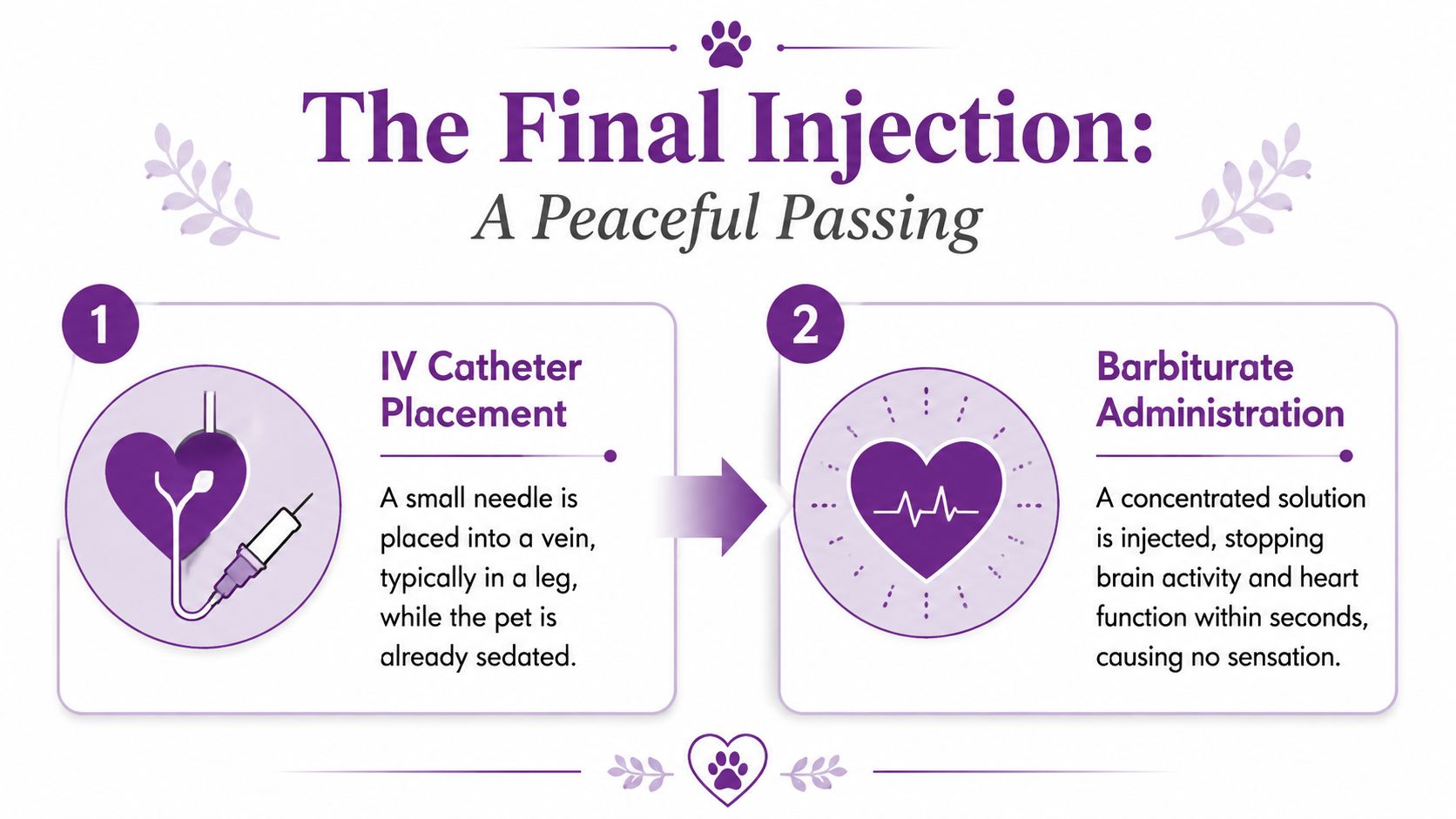
The Final Injection How a Peaceful Passing Happens
Once your pet is sedated and unaware, the veterinarian administers a concentrated barbiturate solution. Pentobarbital is the most commonly used euthanasia drug for dogs and cats in private practice, and veterinary literature based on AVMA guidance identifies the intravenous route as the preferred route for this medication. The Journal of the American Veterinary Medical Association discussion of companion-animal euthanasia explains this route and medication choice in more detail.
The veterinarian may place an IV catheter in a vein, often in a back leg, after your pet is already calm. This allows the medication to enter the bloodstream smoothly and lets the veterinarian avoid unnecessary movement or repeated attempts while your companion is resting.
The drug works by suppressing the brain’s activity that supports consciousness and vital function. In plain language, awareness goes first, followed by breathing, and then heart function. Because your pet is already unconscious from sedation, they don’t experience the final medication as pain or fear.
Three physical mechanisms
The AVMA’s euthanasia guidance describes three primary mechanisms involved in injectable euthanasia:
- Brain depression: The drug directly depresses neurons essential for life, causing loss of consciousness and pain perception.
- Hypoxia: As breathing stops, the body no longer receives oxygen in the usual way.
- Disruption of brain activity: Electrical activity that supports vital function ceases as the medication takes effect.
These mechanisms explain why the process can look quieter than families expect. Your pet doesn’t need to struggle or react for the medication to be working. The veterinarian observes physiologic signs and remains attentive throughout.
In an equine electrophysiology study described in the AVMA euthanasia guidelines, brain death occurred within 73 to 261 seconds of intravenous pentobarbital infusion, while cortical electrical activity could disappear during the infusion or within 52 seconds after completion. This is one reason the visible loss of a heartbeat may not occur at exactly the same moment as irreversible brain death.
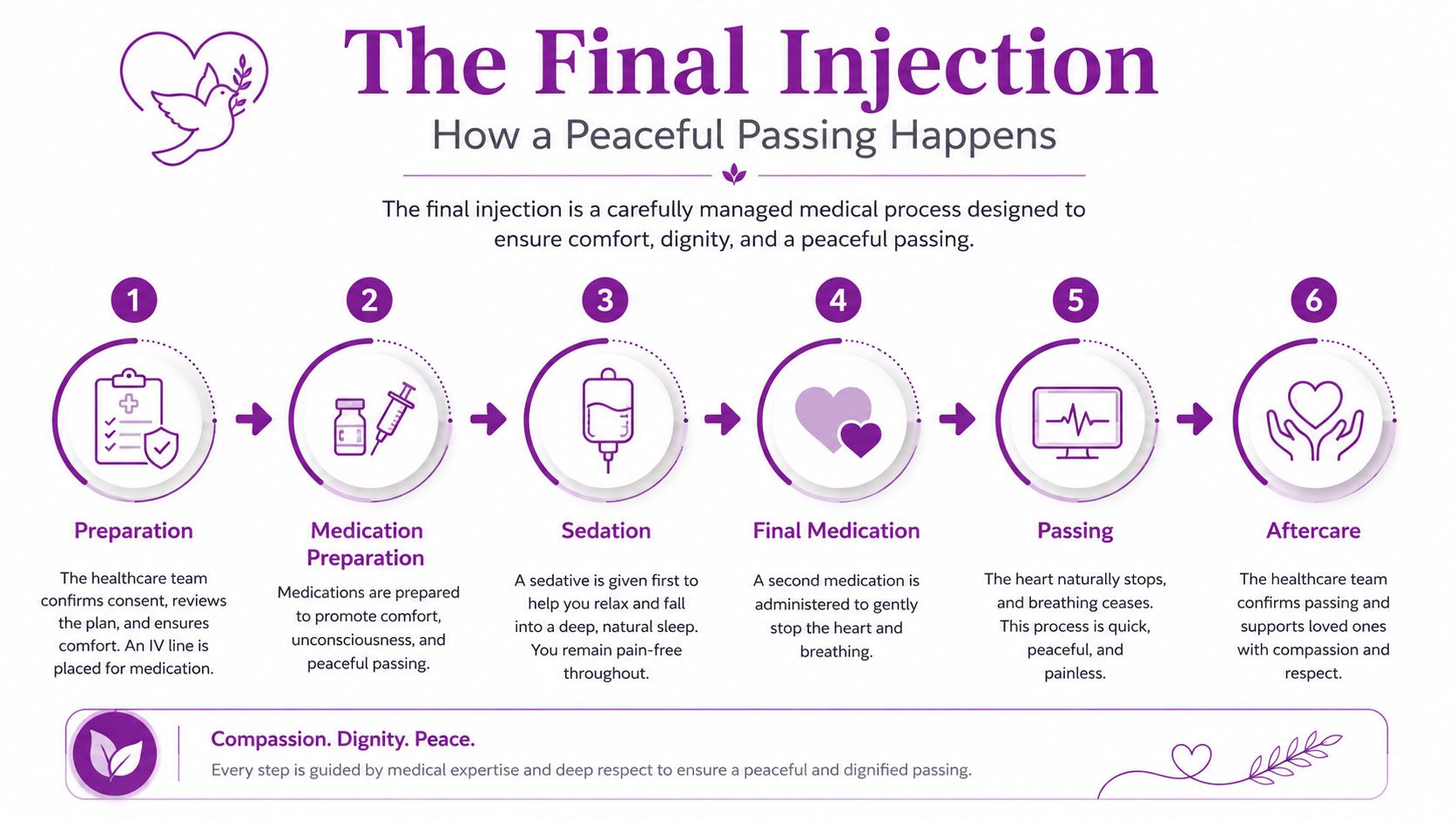
The veterinarian won’t assume that the injection has worked just because your pet appears still. The AVMA states that death must be confirmed before the animal’s remains are handled for aftercare, with the absence of a heartbeat serving as the most important indicator of death. The veterinarian may listen with a stethoscope, watch for breathing, and assess other neurologic and physiologic signs.
That confirmation can take several quiet minutes. When the veterinarian tells you your pet has passed, the words may feel both expected and unreal. You don’t need to respond immediately. You can keep your hand on your companion, speak their name, or sit in silence.
What You May See After Your Pet Has Passed
Some physical signs can occur after death, even when the passing has been peaceful and complete. Knowing about them beforehand can help prevent a startling moment from becoming a frightening memory.
Your veterinarian may prepare you for:
- A final breath or two: A last breath can sound louder than your pet’s normal breathing. It may be a reflexive release of air, not a sign of awareness.
- Urination or defecation: Muscles relax after death, and the bladder or bowel may release.
- Small movements: You may notice twitching in the legs, neck, eyelids, or other muscles.
- Fluid or foam: A small amount of foam or blood-tinged fluid may appear at the nostrils.
The University of Illinois veterinary teaching hospital guidance specifically warns families about urination, defecation, loud final breaths, foam or blood at the nostrils, and twitching. These signs can happen during a normal euthanasia and don’t mean your pet is suffering.
Reflexes aren’t awareness
The distinction is important. A reflex is a physical response from muscles or tissues after consciousness has ended. It doesn’t mean your pet is frightened, trying to wake up, or experiencing pain.
The veterinarian has already assessed your pet’s awareness and comfort before giving the final medication. After the passing, your companion may look different because the body is no longer maintaining its usual muscle tone, but that appearance doesn’t indicate distress.
If something worries you, ask immediately. The veterinarian can tell you what you’re seeing and confirm whether it fits the expected physical response.
After confirming the absence of a heartbeat and breath, the veterinarian will usually give your family privacy. There may be tears, stillness, conversation, or laughter as you remember an ordinary moment that suddenly feels precious. None of these responses is wrong.
You can take as much unhurried time as you need before discussing aftercare. If you’re not ready to make a choice, tell the veterinarian. When possible, planning preferences before the appointment can reduce the number of decisions you need to make in this tender period.
Aftercare Choices and Honoring Your Pet’s Memory
After your pet has passed, aftercare becomes a practical expression of love. You may choose private cremation, communal cremation, aquamation, or another option available in your area and consistent with your family’s wishes.
Private cremation generally means your pet’s ashes are returned to you. Families may select an urn, a simple container, or a memorial vessel that fits the pet’s personality and place in the home. Communal cremation provides a shared aftercare option when individual ashes aren’t requested.
Aquamation, also called water-based cremation, uses water as part of the aftercare process. Some families prefer it as an alternative to flame-based cremation. Ask the provider how each option works, how your pet is identified, and whether ashes or mineral remains will be returned.
Keepsakes can make remembrance tangible
You don’t need to choose every memorial item. One meaningful object may be enough.
- Paw prints: A clay or ink print can preserve the shape of a familiar paw.
- Fur clippings: A small clipping from a favorite place, such as the chest or tail, can become a private keepsake.
- Memorial jewelry: Some families choose jewelry designed to hold ashes or another small remembrance.
- Urns: An urn can be displayed, placed in a quiet memorial space, or kept privately.
- Personal rituals: Letters, photographs, music, candles, and celebration-of-life gatherings can honor the everyday bond.
Heartstrings Pet Hospice coordinates aftercare logistics directly with families, including cremation choices and memorial options, so the first hour doesn’t have to carry every decision at once. You can ask what will happen next, who will transport your companion, and when you can expect updates.
The broader end-of-life context can also help families understand why this decision feels so different in clinical care and shelter settings. In a 2024 analysis of deceased cats and dogs from a veterinary referral population, euthanasia was the recorded manner of death for 23,910 of 24,006 cat deaths, or 99.6%, and 28,046 of 28,159 dog deaths, also 99.6%. Shelter outcomes tell a different population-level story. Across 1,373 shelters, total euthanasia outcomes declined 56%, from 713,557 to 311,054 over the study period, while the study estimated 265,578 dogs and cats were euthanized in shelters in 2020, down 44% from 475,489 in 2019. The 2024 Scientific Reports analysis of shelter and veterinary data shows why setting matters when people interpret euthanasia numbers.
Support for the days afterward
Other pets may notice the absence, seek familiar rooms, change their appetite, or become quieter. Some show little visible reaction. Keep routines steady, offer calm companionship, and speak with your veterinarian if changes persist or concern you.
Children may grieve in waves. They might ask the same question repeatedly, move quickly between sadness and play, or want to create a drawing or memorial. Honest language and permission to remember are often more helpful than trying to make the loss disappear.
If grief interferes with daily life, feels impossible to share, or brings persistent guilt and isolation, professional support can help. Families looking for compassionate grief counseling approaches may find it useful to learn how grief therapy can support emotional processing. Heartstrings also offers pet loss grief support resources and may help families identify additional community support.
Families sometimes ask:
When should I contact a grief professional? Reach out when your pain feels unmanageable, when guilt prevents rest or connection, or when you want guided support rather than carrying the loss alone.
Is it normal to second-guess euthanasia? Yes. Love often makes families review every decision. A quality-of-life conversation with your veterinarian can help place the decision in the context of your pet’s comfort and suffering.
Do I need to memorialize my pet immediately? No. You can wait. Remembrance can take shape later, when a photograph, song, keepsake, or story feels ready.
Heartstrings Pet Hospice’s care includes hospice support, in-home euthanasia, aftercare coordination, telehospice follow-up, and resources for families after loss. If you have questions about your pet’s comfort or the goodbye ahead, you’re allowed to ask them more than once.
Heartstrings Pet Hospice & In-Home Euthanasia offers in-home hospice, palliative guidance, peaceful euthanasia with sedation, and coordinated cremation or aquamation options for companion animals. When you’re ready, visit Heartstrings Pet Hospice & In-Home Euthanasia to learn about quality-of-life support and compassionate planning for your family.